
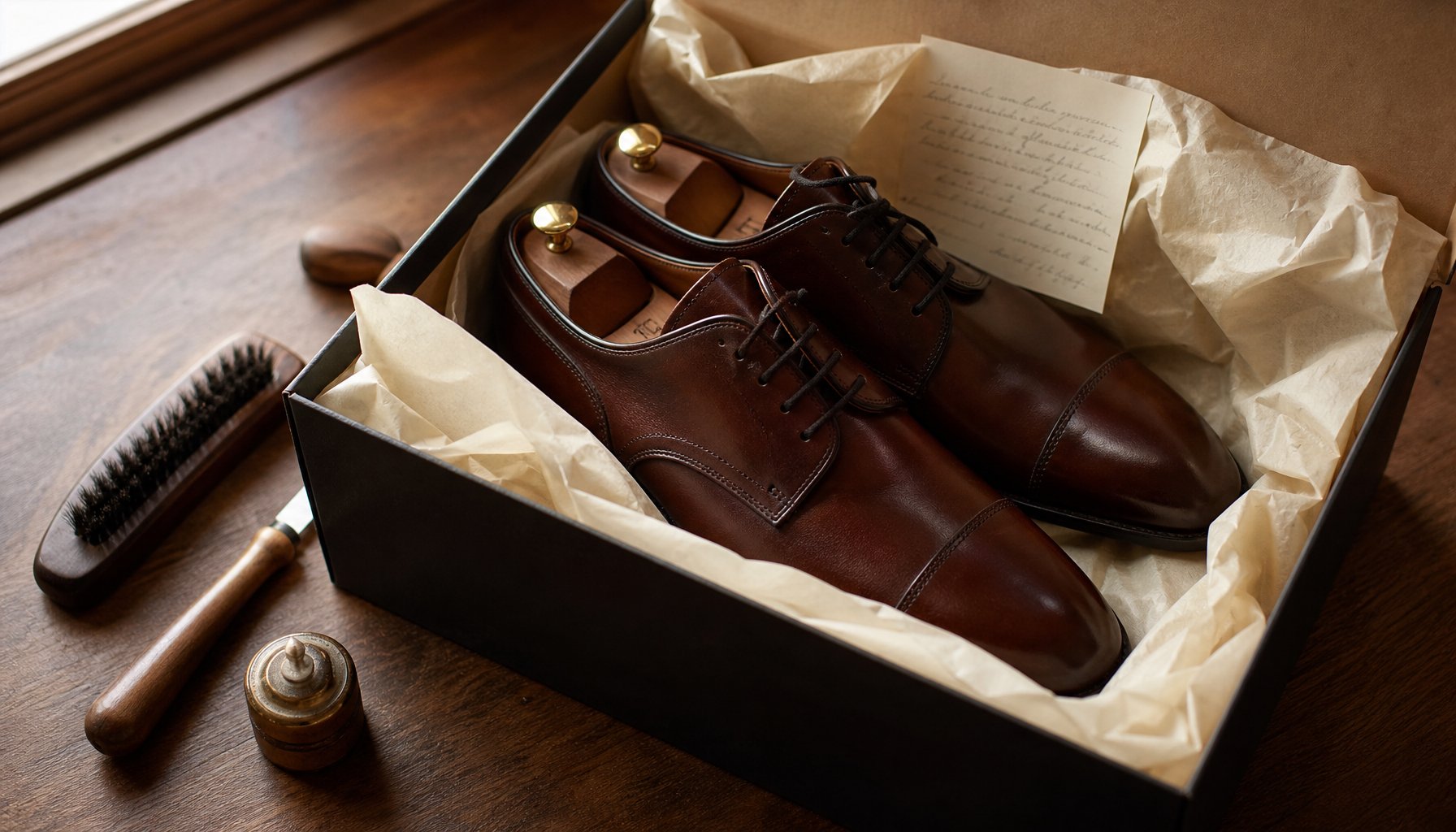
Every Father’s Day gift guide this year opens with the same line: what to get the dad who says he does not want anything. The answer, increasingly, is not something new at all. It is something old, restored to its original condition. A leather briefcase from his first job. A pair of dress shoes he wore to your graduation. A bag he carried for twenty years and then retired. Restoration is not a consolation prize for not buying new. It is the better gift.
Father’s Day gifting tends toward two patterns. The first is replacement — a new wallet, a new pair of shoes, a new jacket. The second is novelty — a gadget, a bottle, an experience. Both work. Neither tends to be the gift that gets mentioned years later.
The third option is the one most people don’t consider until they see the result: take the piece he already owns and bring it back. The boots from his first job. The briefcase from a previous decade. The wallet that has shaped itself to his back pocket over fifteen years. Restoration is not the same as repair, and it is not a substitute for buying something new — it is the recognition that the most valuable object in his closet is often the one with the most history.
What Restoration Actually Returns
A piece of leather that has been worn for years carries two distinct kinds of change. The first is structural — a worn heel, a separated sole, a torn lining, a broken stitch line. The second is surface — the colour has thinned in the high-wear areas, the finish has gone dull, the leather has lost its oil and feels drier than it did when it was new.
Structural change is addressed through reconstruction. The heel block is rebuilt, the sole is re-attached or replaced, the lining is patched or relined, the stitching is repaired. The piece is made wearable again, not for one more season but for several more years.
Surface change is addressed through cleaning, conditioning, and selective recolour. The dirt and oil residue that has accumulated in the grain is lifted. The leather is fed conditioner until it absorbs no more. Where the colour has thinned — across the toe of a boot, along the spine of a wallet, on the shoulders of a jacket — pigment is matched and worked into the surface, then sealed.
What gets returned is not a piece that looks new. That would be the wrong outcome. What gets returned is the same piece, recognisably his, but now wearable. The years are still there. They just stop being a reason to retire the object.
Which Pieces Are Worth Restoring
The honest answer is that some pieces aren’t. A wallet made from bonded leather — layered scraps held together with adhesive — typically cannot be restored, because the substrate fails before the surface does. A pair of shoes with a cracked midsole or a delaminated welt may be more expensive to rebuild than to replace, depending on the original quality. A jacket with sun-bleached and dried leather across the whole back panel may be past the point where conditioning can recover the hide.
The pieces that are clearly worth restoring share a few traits. The construction is solid — Goodyear-welted shoes, a full-grain leather jacket, a vegetable-tanned wallet with even surface ageing. The damage is localised, not systemic. And the piece is one he wears, or would wear again if it looked right.
If you’re not sure, the most useful thing to do is send a photo. A specialist can tell within a minute or two whether a piece is a strong candidate, a borderline case, or genuinely past the point. That conversation is worth having before either gift-wrapping a replacement or assuming the original is finished.
What Fixano Would Do for a Father’s Day Restoration
The process starts with the piece, not the deadline. The condition gets assessed, the construction is checked, and a treatment plan is written for what’s actually needed — not a one-size service.
For shoes: clean, recolour the high-wear areas, recondition, polish to the finish he wears them at. New heels and soles where the wear has reached the welt. For a jacket: full surface clean, deep recondition, colour work on the shoulders and elbows where the leather has thinned, stitch repair on any open seams. For a wallet or belt: edge restoration, surface recolour, replacement of any failed stitching. For a bag or briefcase: full clean, hardware polish or replacement, handle reinforcement or replacement, lining repair.
What gets returned is the piece he already owns, made wearable. The story stays his. The object lives on.
Some of the best gifts are already in the closet. If there’s a piece worth restoring — the Fixano app connects you to shoe, bag, and leather restoration specialists in Los Angeles and Orange County. Share a photo, describe the piece, and find out what a proper restoration looks like.