
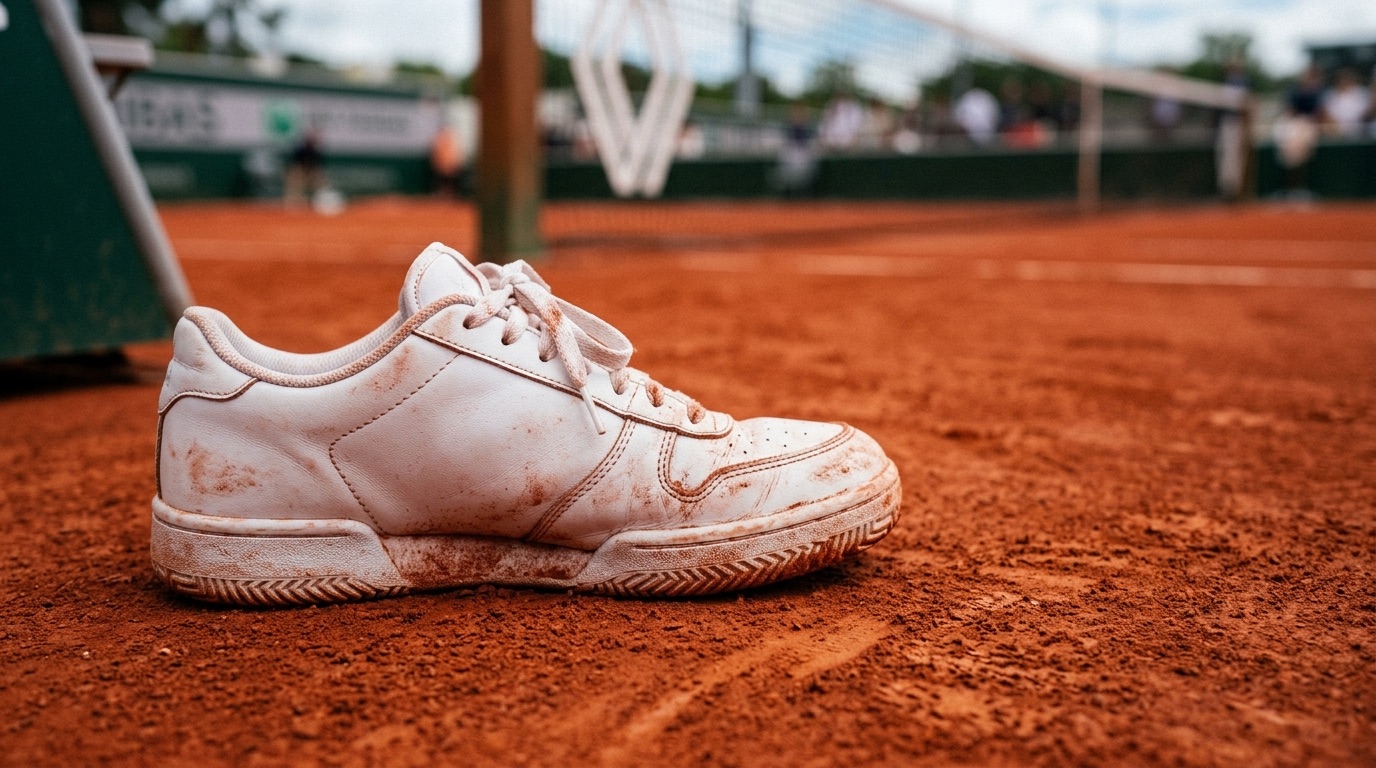
Coco Gauff opened her Roland Garros campaign in the New Balance CG2, a white sneaker that lasted roughly one set before the Paris clay made its presence known. By the end of her first match, the distinctive red dust had colonised every stitch line and seam. At the French Open, the clay does not just mark a shoe — it grinds into the leather, dries it out, and leaves a residue that regular cleaning cannot fully reach.
Roland Garros produces the most visually arresting footwear abuse in professional sport. White sneakers — pristine at the start of a match — emerge coated in a red dust that looks decorative and behaves like cement. Clay season ends the same way every year: with a generation of court sneakers that need serious attention.
What Roland Garros Clay Actually Is
The court surface at Roland Garros is not standard garden soil. It is crushed brick — specifically, fired red terracotta, which gives the court its distinctive colour and its distinctive quality as a staining agent. The iron oxide in the material is what causes the problem: it bonds with white rubber, canvas, and leather in a way that standard dust does not.
When a player (or a spectator, walking through the facility) picks up clay on a white sneaker, two things happen simultaneously. The surface particles coat the exterior — visible immediately. And the finer particles, especially on mesh uppers, work their way into the material weave. The surface particles come off with effort. The particles in the weave require more focused work.
Timing is critical. Wet clay, if you attempt to wipe it immediately, spreads. The conventional instinct — clean it now before it sets — works for most soils and makes clay worse. The correct approach with clay is to let it dry completely before touching it.
The Cleaning Sequence That Works
Wait until the clay is fully dry. It will have contracted slightly as it dried and the bond with the surface is more brittle than wet clay. Begin with a stiff dry brush — a natural-bristle shoe brush or a dedicated sneaker brush — to remove as much of the dried clay as possible before introducing any liquid. Skipping this step means you are turning dry clay back into a paste and reintroducing it to the upper.
Once the bulk of the dry clay is off, move to a cleaning solution. On leather and rubber components — the toe cap, midsole, outsole — a paste of baking soda and a small amount of dish soap, applied with a soft toothbrush and worked in circular motions, removes most residue. Work in small sections. Wipe clean with a damp cloth before the paste dries.
On mesh or fabric uppers, a dedicated sneaker cleaner works better than home remedies. Apply with a soft brush, work it into the mesh in the direction of the weave, and allow it to lift the particles rather than scrubbing them in. Multiple passes beat one aggressive attempt.
Rubber soles are the easiest component — the surface is non-porous and clay does not penetrate. A Magic Eraser on the midsole edges removes most residue in seconds.
What Fixano Would Do With Clay-Season Sneakers
A pair of white court sneakers after Roland Garros season — or a week in Paris where the grounds were walked — arrives for a full sneaker restoration: upper clean, midsole clean, lace replacement if needed, and a protective coating applied after cleaning. The protective coat does not make the next clay exposure invisible, but it creates a surface from which clay releases more easily.
The work is methodical. Clay restoration is not a thirty-minute job if it is done properly. Rushing the process — or attempting to force dry clay off before it has fully contracted — creates micro-abrasions in mesh that catch future soiling more readily than the original surface.
Clay season leaves a mark. If your sneakers came back from Paris looking like they played five sets themselves, the Fixano app connects you to sneaker restoration specialists in Los Angeles and Orange County. Upload a photo, describe what you’re working with, and find out what can be recovered.