
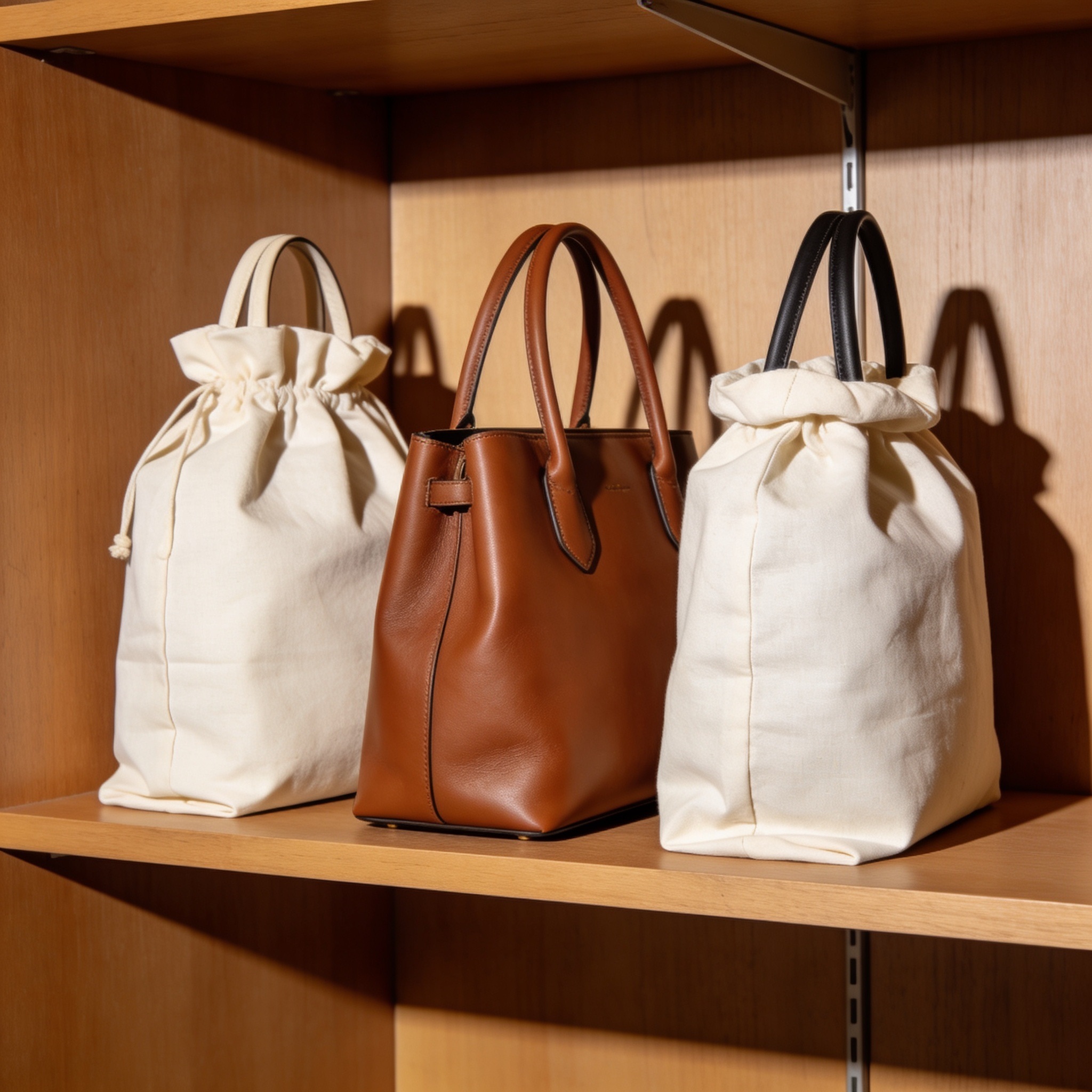
Most leather bags are cared for attentively when they are being used, and forgotten about the moment they go into a wardrobe. Months later they emerge slightly worse than they went in. The leather is drier. The hardware has started to do something interesting. A corner has compressed in a way it did not have before. None of this was inevitable. How you store a leather bag matters as much as how you clean it.
There are five variables that matter: the container, the structure support, the light exposure, the air circulation, and the humidity.
The Dust Bag — More Than a Branded Sleeve
Every luxury bag ships with a dust bag. Most owners lose theirs within a year, then buy something in the interim and call it equivalent. It rarely is.
A dust bag does three jobs: it blocks the UV light that fades leather dye over time, it prevents surface dust from abrasively settling onto the leather during long storage, and it keeps hardware from oxidising against humid air. A bag that lives in its dust bag for five years looks meaningfully different than the same bag on an open shelf. The difference is visible in the colour depth and the hardware finish.
Fixano includes a dust bag with every restored item — not branded, not decorative, just the right soft cotton, breathable, sized correctly. Caring about what happens after the restoration is part of the restoration.
If the original dust bag is gone, a clean cotton pillowcase works well. The criteria are: natural fibre, breathable, clean, sized so the bag sits in it without being compressed. A new dust bag from the brand or a third-party cotton version is worth the few pounds — it pays back over years of storage.
How to Support the Structure
Structured bags — those with frames, internal stiffening, or a defined silhouette — should be stuffed lightly before storage. The goal is to maintain the bag’s shape without stretching the leather or distorting the sides.
Use acid-free tissue paper rather than newspaper (the ink transfers) or plastic bags (moisture trap). For a medium structured bag, two or three loosely crumpled sheets is enough. The bag should hold its shape without the stuffing creating visible bulges.
Unstructured bags — soft leather totes, hobo styles, bucket bags — can be stored flat or loosely folded if needed, but avoid sharp folds along the same lines repeatedly. Leather that folds in the same place consistently eventually cracks along that line.
Shoulder straps and handles should be tucked inside the bag or laid flat rather than hung over the edge where they can develop a permanent crease. Chains and metal-handled bags can be wrapped loosely in the tissue paper to prevent the hardware from pressing against the leather.
Light — The Slow Damage
Leather fades. Direct sun accelerates the process significantly, but indirect UV exposure over years also shifts the colour. A bag that lives on an open shelf in a room with natural light will fade unevenly — the top surface and any side facing the window moving faster than the rest.
Store leather bags away from windows and away from artificial UV sources. A wardrobe or closed shelf is better than a display shelf. If the bag is on display, rotate it occasionally and check periodically that the colour is remaining even.
How to Store Leather Bags for Long Periods
Long-term storage — anything over three months, or seasonal storage between uses — requires additional preparation.
Condition the leather before it goes into storage. This is the most commonly skipped step and the one with the most consequence. Dry leather left in storage becomes more dry. A conditioned bag enters storage with its moisture balance maintained and emerges from three months or six months in a state far better than unconditioned leather would. Apply a quality leather conditioner, allow it to absorb fully, and buff off any excess before the bag goes away.
Clean before storage. Surface dirt, oils from handling, and any product residue should be removed before a bag is stored for a long period. Dirt left on leather over months can work its way into the surface or cause uneven oxidation. A light clean with a leather cleaner followed by conditioning is the proper pre-storage routine.
Avoid stacking. Bags stacked on top of each other develop pressure marks and shape distortion over time. Store upright, side by side, with enough space between them that the hardware isn’t pressing against adjacent leather.
Temperature and Humidity
Leather is sensitive to extreme temperature swings and to persistent humidity. Storage environments to avoid:
- Attics — temperature swings too wide, often humid in summer
- Basements — high ambient moisture unless actively controlled
- Garages — same concerns plus fumes and particulates
- Directly above or beside radiators — dry heat is harder on leather than cold
A bedroom wardrobe is ideal for most people — relatively stable temperature, moderate humidity, protected from light and traffic. If the storage area is notably humid (coastal locations, older buildings), a small silica gel packet inside the dust bag absorbs excess moisture without overdrying the leather.
How to Store Shoes Long Term
The principles for how to store shoes long term follow the same framework: clean and condition first, support the shape, block light and dust, control humidity.
Cedar shoe trees are worth the investment for leather shoes going into storage — they absorb residual moisture from the leather, release cedar oils that deter insects, and maintain the shoe’s last precisely. For shoes without trees, stuffed acid-free tissue is the minimum. Original shoeboxes are good for structure if the shoes are first placed inside breathable bags — the cardboard itself can transfer a faint mustiness over time.
What Fixano Restores
A bag that emerges from poor storage — with compression marks, dried leather, tarnished hardware, or a dusty, uneven surface — is a candidate for leather bag restoration. Surface cleaning, reconditioning, and in some cases colour correction bring bags back from the consequences of storage. If the bag simply needs hydration after a long rest, use a conservative leather-conditioning process and test any product on a hidden area first.
If a bag has been in storage and arrives in worse condition than it went in, the Fixano app connects you with restoration specialists across Los Angeles and Orange County. Photograph the current condition and describe what you’re seeing — the team assesses what it needs before any work begins.