
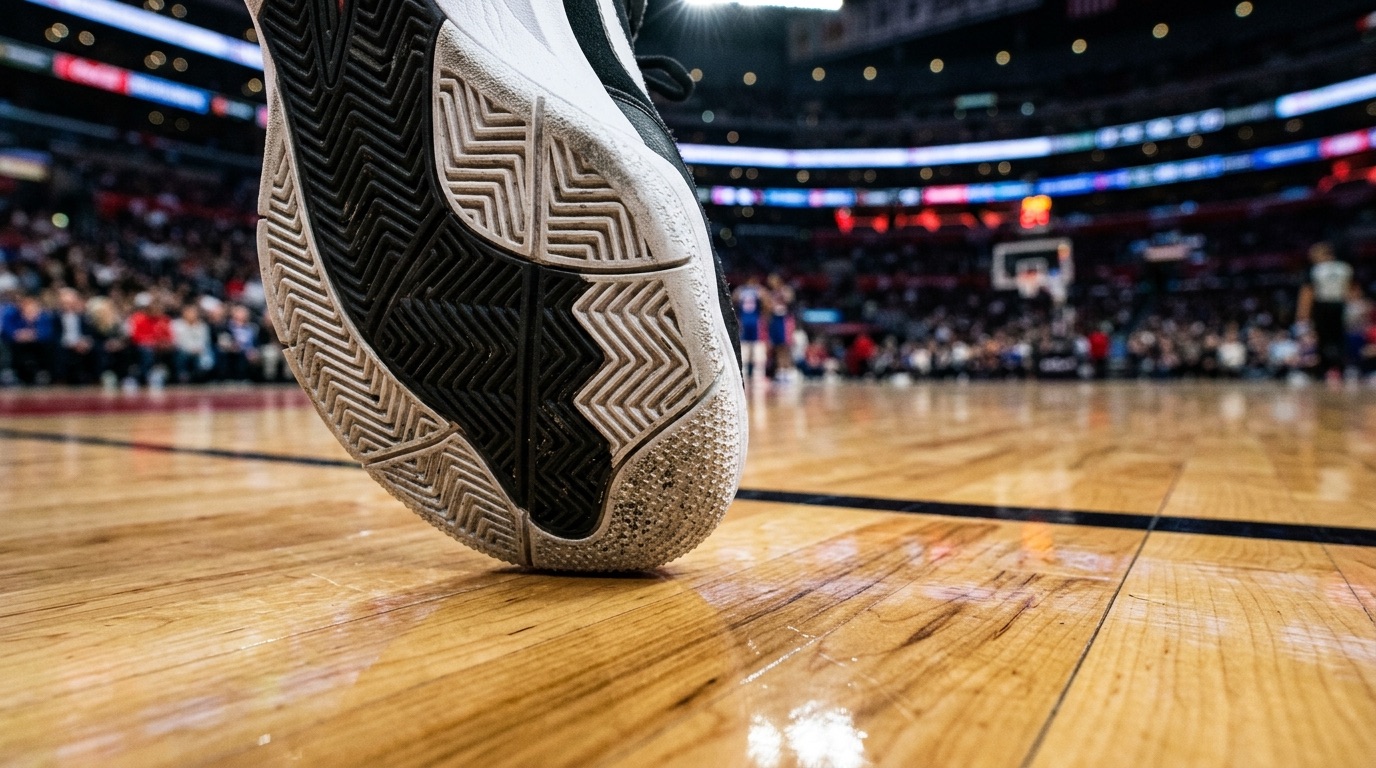
Devin Vassell debuted the Book 2 “Haven and Hector” in the Western Conference Finals opener, and within three games the wear pattern told its own story — heel drag from defensive slides, toe creasing from hard stops, scuffing across the lateral edge from a week of playoff basketball. The Conference Finals are a compressed showcase of what a sneaker endures at the highest level. By the time the Finals tip off, the pairs worn in Game 1 already belong to another era.
There is a gap between how NBA sneakers look on television and what happens to them during the game. The broadcast shows a clean, pristine pair at tip-off. What the broadcast does not show is the court dust, rubber transfer, and friction damage that accumulates over forty-eight minutes on a hardwood floor. Professional players rotate to a fresh pair after one to three games. Everyone else lives with what they have.
What a Basketball Game Does to Sneakers
Hardwood courts are finished with a polyurethane coating that provides the consistent, high-traction surface the sport requires. That coating — and the layers beneath it — releases a fine dust under the pressure of constant lateral movement and stops. It is the reason players wipe their soles during dead balls.
This court dust accumulates in the rubber tread of the outsole and migrates up the midsole edge during play. On white sneakers, it reads as grey-brown discolouration within the first quarter. On black outsoles it is nearly invisible — which is why many performance basketball shoes use dark rubber on the bottom regardless of the upper colourway.
The lateral cutting movements specific to basketball also stress sneakers differently than running or walking. The medial side of the outsole — the inner edge — takes repeated pressure from plant-and-cut mechanics. Over time, this produces uneven wear patterns and sole separation starting at the ball of the foot, which is where most pivoting occurs.
Care After Court Wear
Court sneakers need attention after every wear, not just when they look dirty. The dust that enters the sole tread is visible. The sweat that saturates the insole and lining is not, and it is the source of long-term odour and material breakdown that shortens a shoe’s useful life more reliably than surface soiling.
After court use: remove the insoles and allow both shoe and insole to air fully before putting them back. Compressing a damp insole inside a closed shoe creates the conditions for mould growth and permanent odour transfer to the leather lining.
For the exterior: a soft brush to remove loose court dust from the sole, midsole cleaner applied with a soft toothbrush, and an upper wipe-down with a damp cloth. Allow to dry at room temperature — not in direct sunlight, which degrades rubber and can cause premature yellowing of white soles. Cedar inserts in storage slow the moisture buildup that causes lining breakdown.
What Fixano Would Do With Post-Season Court Sneakers
A pair of basketball sneakers at the end of an NBA season — or at the end of a recreational court season — arrives for a full restoration assessment. This is usually: deep sole clean, upper restore, insole replacement if the original is beyond recovery, and a protective coat applied to the clean midsole before the next season begins. The protective coat does not make the shoe permanently clean, but it raises the threshold of how much a session’s dust actually adheres.
For limited-edition or collectible pairs used on court — a more common scenario than most people admit — the restoration work is more considered. The goal is to return the shoe to a condition that reflects the care taken with the pair, not to make it look as if it was never worn.
If your sneakers came through the playoffs looking like it — the Fixano app connects you to sneaker restoration specialists across Los Angeles and Orange County. Upload a photo, describe the wear history, and find out what a proper restoration looks like.