
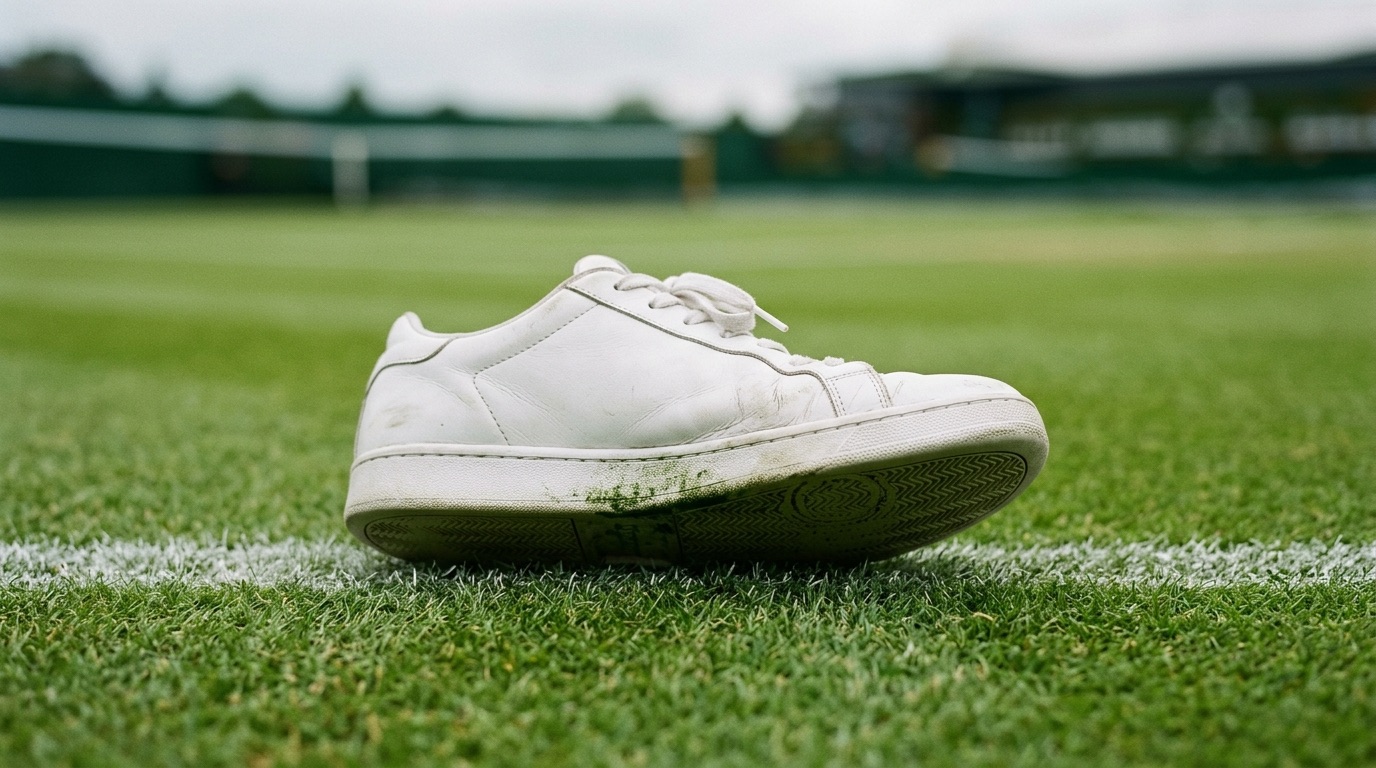
Naomi Osaka’s sequined, ruffled French Open looks drew international attention — and immediately raised a question circulating across tennis media: would those outfits even be allowed at Wimbledon? The All England Club’s all-white dress code governs footwear as strictly as clothing. Every shoe on Centre Court this July will be white. On grass. Against a backdrop of precisely mown green. The cleanest visual in sport, and the hardest to keep that way.
Wimbledon enforces an all-white dress code that applies to competitors and has influenced spectators for decades. White shoes — leather, canvas, or court sneaker — are the default. The grass courts are pristine at the start and progressively marked by two weeks of tennis. The English weather, which ranges from warm and humid to actively wet within a single afternoon, does the rest.
What Grass Courts Actually Do to White Shoes
Grass is a more aggressive soiling surface than it appears. The courts at Wimbledon are maintained to a specific grass height and density, but the underlying mechanics are the same as any natural grass surface: a layer of chlorophyll-rich blades over damp soil, which becomes softer under foot traffic and rain.
Walking on grass deposits two things on white shoes simultaneously: chlorophyll (the green pigment in the grass) and soil. On the sole and outsole edge, the accumulation is immediate and visible. On the upper, contact with wet grass blades leaves a faint green transfer — more visible after the shoe dries than when it is still wet.
Chlorophyll is a pigment that bonds with porous materials. On rubber and synthetic soles, it sits on the surface and can be removed with a standard cleaner and a brush. On coated leather, it adheres to the surface finish and can usually be removed with a good leather cleaner. On canvas, mesh, or uncoated leather, it penetrates and requires more deliberate treatment — in some cases, professional colour work — to fully remove.
The weather compounds the problem. Humidity softens the grass further and reduces the shoe’s ability to dry between wears, which means soiling accumulates faster. A rain event during a session means wet grass transfer is more significant — and water marks on white leather, if not managed properly, leave mineral rings as they dry.
The White Shoe Care Protocol for Outdoor Events
Before the event: apply a protective spray to the upper and allow it to cure for at least eight hours. The spray does not make the shoe waterproof or stain-proof — it creates a surface the soiling adheres to less readily, which means cleaning after the event is more effective.
At the event: do not attempt to clean during wear. A quick wipe with a damp cloth during the day will smear rather than lift chlorophyll on leather. Address it properly after.
After the event, while the shoes are still slightly warm: a soft brush to remove loose debris, leather cleaner on a cloth worked into any green transfer on the upper, and sole cleaner on the tread. If there are water marks from rain exposure, dampen the entire affected panel lightly with a clean damp cloth and allow it to dry evenly — this prevents the ring from forming.
Condition after cleaning, always. Any cleaning product removes some of the leather’s natural oils, and white leather that dries without conditioning shows the loss immediately as a subtle stiffness and surface change.
What Fixano Would Do After Wimbledon
A pair of white leather or canvas shoes after two weeks at SW19 typically arrives with grass transfer on the upper, soil accumulation on the sole edges, and — if the fortnight included rain days — some water marks. The restoration sequence starts with a full clean before any colour work, because applying conditioner or restorative product over surface soiling seals it in.
If the upper has green staining that hasn’t lifted with cleaning, colour restoration returns the white base. For shoes with significant water damage or ring marks, a full re-finish may be more appropriate than trying to address individual marks on an otherwise aged surface.
White shoes and outdoor events are an ambitious combination. If the fortnight left a mark — the Fixano app connects you to shoe and leather restoration specialists in Los Angeles and Orange County. Share a photo, describe what happened, and find out what a proper clean and restore looks like.