
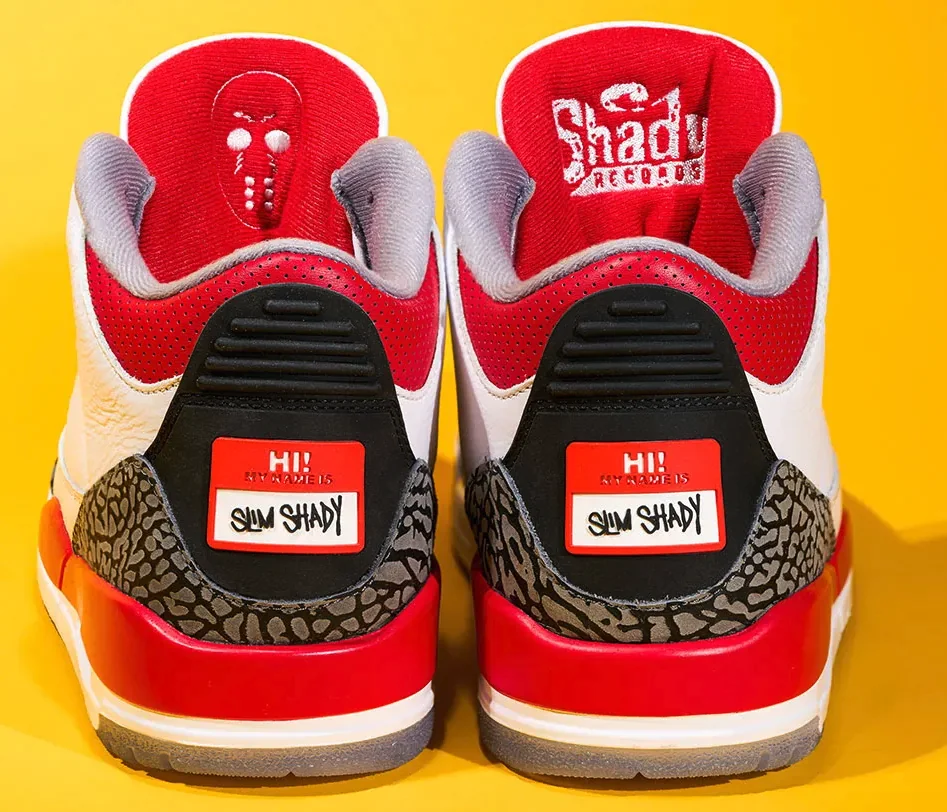
Eminem has put 117 pairs of his own sneakers up for auction, every one of them hand-signed, with proceeds going to the Marshall Mathers Foundation. Bidding closes on 25 August. The collection runs through Nike, Jordan Brand, PUMA and Adidas, and the headline pairs are not the pristine ones. They are the ones he wore.
That detail is worth sitting with. In a market that has spent a decade telling people that unworn is the only condition that counts, the most valuable shoes in this auction are valuable because someone put them on.
The pairs that carry the most weight are the ones with history
Among the lots are the custom Air Jordan 3s made for the Super Bowl LVI halftime show, where Eminem performed alongside Dr. Dre, Snoop Dogg, 50 Cent, Kendrick Lamar and Mary J. Blige. Reports put the production run at 45 pairs, none of which were ever released publicly. There is also a Carhartt collaboration on the Air Jordan 4, made to mark fifteen years of Shady Records, originally limited to ten pairs through a charity auction.
Those numbers explain part of the value. Scarcity always does. But scarcity alone does not explain why a worn pair with a signature outperforms a sealed pair without one.
The answer is provenance. A shoe that was worn somewhere specific carries proof of having been there. The creasing across the toe box is not a defect in that context. It is the receipt.
Wear is evidence, not failure
The sneaker resale market trained a generation to read wear as loss. Deadstock, unworn, never laced — the vocabulary is all about absence. Absence of use, absence of story.
Then an auction like this comes along and inverts it. Here, the wear is the point. The shoes are worth what they are worth because they went somewhere.
Most people will never own a pair with a stage history. But the same logic applies at a smaller scale, and it applies to almost everyone. The sneakers you have worn for four years hold something the same model bought new tomorrow would not. You just have not been told to value it.
The line between patina and damage
This is where the distinction matters, and where most people get it wrong in both directions.
Patina is the record of use that has settled. Leather that has softened and taken the shape of a foot. Creasing that runs with the flex point. A midsole that has yellowed evenly and slowly. None of this is failing. It is a material doing what the material does.
Damage is different because damage is still moving. Cracking that opens further with each wear. Midsole separation. Stitching that has let go at the heel counter. Yellowing that is spreading rather than uniform. Left alone, damage compounds.
The skill in restoration is telling these apart, and then resisting the urge to treat the first as though it were the second. A pair stripped back to factory condition has lost the thing that made it worth keeping.
Why “restore” and “repair” describe different work
A repair addresses a fault. A sole comes loose, it gets re-bonded. A heel wears down, it gets replaced. The shoe walks again, and that is a real and necessary job.
A restoration takes in the whole piece. It assesses what to preserve and what to bring back, accounts for material ageing the owner cannot see, and finishes somewhere that is not new — it is the same shoe, structurally sound, ready for another decade.
The difference shows up most clearly on exactly the kind of pair in this auction. A repair mindset asks what is broken. A restoration mindset asks what is worth keeping.
What we would actually do with a signed pair
If a hand-signed, stage-worn sneaker arrived at the workshop, the first decision would be about the signature, and it would be a decision to leave it entirely alone. Marker ink on leather is far less stable than people assume. Most consumer cleaners will lift it or blur the edges. It gets masked and worked around, permanently off-limits.
From there the work is conservative. Dry removal of grit before anything wet touches the upper, because grinding loose dirt into leather during a wet clean does more damage than the dirt was doing on its own. Targeted treatment of the areas that are actively deteriorating. Conditioning matched to the specific leather rather than whatever is on the shelf.
What would not happen: no aggressive whitening of a yellowed midsole that is yellowing evenly, no re-dyeing to hide honest creasing, no attempt to make a fifteen-year-old shoe photograph like a new one.
Storage does more damage than wearing ever did
The uncomfortable truth for anyone holding shoes as an investment is that most deterioration happens in the closet, not on the foot.
Polyurethane midsoles hydrolyse whether or not the shoe is worn. Glue lines dry out. Leather that never flexes stiffens and then cracks at the first flex. A shoe sealed in a plastic box with no airflow traps humidity against its own materials for years.
If a pair matters, the care that protects it is boring and unglamorous. Clean before storing, because dirt keeps working. Keep it out of direct light. Let it breathe rather than sealing it. Check on it occasionally.
The pairs that survive decades are rarely the ones that were treated most preciously. They are the ones that were kept clean and allowed to age in reasonable conditions.
Most people try something first, and that is normal
The pattern we see constantly: someone reaches for a drugstore conditioner, or follows a video, or trusts a whitening product on a midsole that did not need whitening. Then the piece arrives with an extra problem layered on top of the original one.
Nobody should feel bad about this. Everyone tries it themselves first. It only means the work takes longer, because there is an additional step before the actual restoration begins — undoing the attempt.
The honest guidance is narrow. Regular cleaning, correct storage and a conditioner suited to the material are worth doing at home. Anything involving colour, structure, adhesive or an irreplaceable pair is worth handing over. If the shoe cannot be replaced, the margin for experimentation is zero.
The shoes in your closet already have a story
Very few people are bidding on stage-worn Jordans this month. But the principle underneath the auction is not reserved for famous shoes.
The pair you wore through a job you hated. The ones from a trip you would repeat. The sneakers that stopped being a purchase somewhere around year two and became yours. Those are not worth less because they show it.
They are worth keeping in a condition where they can carry on.
What Fixano Restores
Fixano restores sneakers, dress shoes, boots, handbags and leather goods across Los Angeles and Orange County — over 500 pieces to date. Deep cleans return in two to three days; full restorations in around seven. For sneakers specifically, sneaker restoration covers structural and colour work, while sneaker cleaning handles regular upkeep. Scuffing is one of the most common things owners ask about, and removing scuff marks from shoes covers what is worth attempting yourself. For suede pairs, restoring suede shoes sets out where the limits are.
If a pair in your closet deserves better than the state it is in, the Fixano app connects you with restoration specialists across Los Angeles and Orange County. Photograph the damage, get options, arrange pickup — from your phone. Pickup and return throughout LA and OC, so the piece never has to sit in a queue somewhere while the moment passes.