
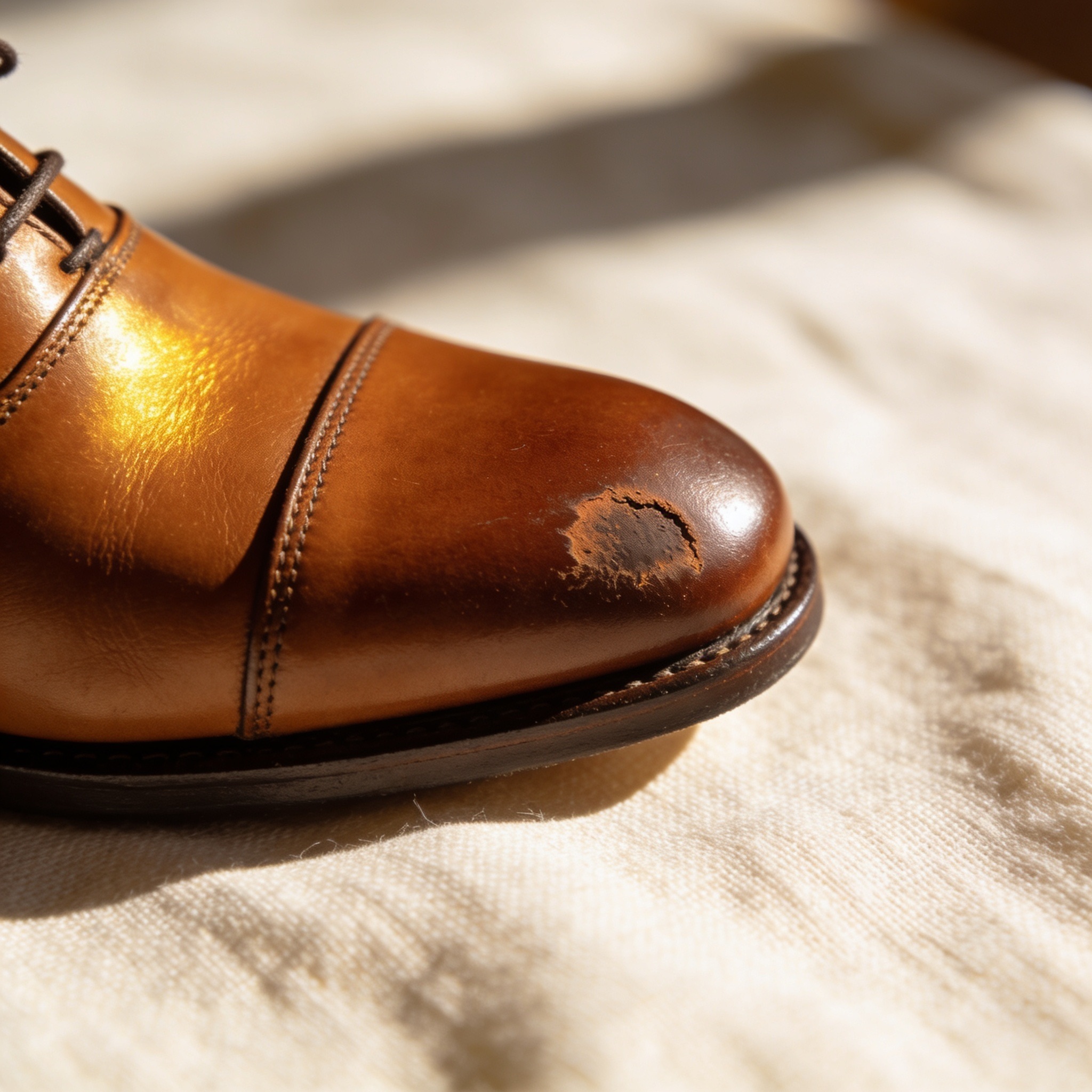
Scuff marks on shoes appear at the worst moments. The kerb, the door frame, the other shoe mid-stride — leather has a talent for finding surfaces that leave their mark on it. The good news is that most scuffs are surface transfers: another material has left itself on your leather, and with the right approach, it leaves as well. Some scuffs are more serious. Knowing which type you are dealing with is the work.
Some scuffs are deeper. A hard impact against a kerb, a door frame catching the heel counter, the back of one shoe scraping the back of the other mid-stride. These may have broken through the leather’s finish and require a different approach. Knowing which type of scuff you are dealing with determines the method — and whether home treatment or professional restoration is the right call.
Two Types of Scuff — Understanding the Difference
Type 1 — Surface transfer: The scuff mark is material from another surface deposited on top of your leather. A kerb leaves concrete dust, a chair leg leaves paint, a dark bag leaves dye. The leather underneath is intact. These scuffs respond well to home treatment.
Type 2 — Abraded leather: The scuff has removed part of the leather’s surface — the finish, the dye, or even the grain itself. The mark is not what has been added but what has been taken away. The leather looks raw or pale in the affected area. These scuffs require professional colour restoration and, in some cases, surface refinishing.
Looking at the scuff under good light at an angle helps distinguish between the two. A surface transfer will appear as a foreign mark on an otherwise intact surface. Abraded leather will look dull, pale, or have a different texture from the surrounding area.
How to Remove Scuff Marks from Leather Shoes
Step 1 — Try petroleum jelly first. Apply a pea-sized amount to a clean cloth. Work it into the scuff mark in circular motions. Petroleum jelly works by emulsifying the surface transfer and lubricating the mark so it releases from the leather. Buff clean with a dry section of the cloth. This handles the majority of scuffs on smooth, calfskin leather.
Step 2 — If the mark persists, try a leather cleaner. A dedicated leather cleaner (Leather Honey, Cadillac, Saphir) applied with a soft cloth can lift marks that petroleum jelly has only partially addressed. Use the cleaner on a cloth, not directly on the leather. Work in small circular motions.
Step 3 — For stubborn colour transfers. A small amount of isopropyl alcohol (70%) on a cotton swab, applied specifically to the mark rather than the surrounding leather, can dissolve pigment transfers that cleaners leave behind. Use carefully — swab the mark only, do not flood the surrounding area, and condition the leather after with a quality leather conditioner.
Step 4 — Condition after treatment. Any cleaning removes some of the leather’s natural oils. Apply a leather conditioner after any scuff removal treatment, regardless of the method used.
How to Remove Scuffs from Leather Shoes — Heel Counter and Toe Box
The heel counter and toe box are the two areas that collect the most scuffs. On dress shoes, the toe box is particularly vulnerable to the heel of the other shoe striking it when walking. On loafers and court shoes, the heel counter catches doorframes and furniture.
The toe box on leather dress shoes often has a harder finish than the body of the shoe — many manufacturers apply a welt or protective coating over the toe that makes scuff removal slightly easier here. The heel counter is usually softer and more porous.
For the heel counter, avoid alcohol-based methods unless necessary — the leather here is often thinner and dries more quickly. Petroleum jelly followed by a quality conditioner is the safest approach.
How to Remove Scuff Marks from Patent Leather Shoes
Scuffs on patent leather are a different problem. The mirror finish makes marks highly visible, and the lacquer surface behaves differently from smooth leather.
For surface transfers on patent leather, petroleum jelly is again the first tool: apply sparingly, work into the mark, buff clean. The lacquer surface actually releases surface transfers more easily than smooth leather in many cases.
For more stubborn marks — the kind that have a visible colour different from the lacquer — a small amount of nail polish remover on a cotton swab applied directly to the mark (not the surrounding lacquer) can dissolve the transfer. This method requires precision. Nail polish remover on a larger area of patent leather will dull the finish.
The how to clean patent leather guide covers the full patent leather cleaning process in more detail.
How to Remove Scuff Marks from Suede and Nubuck Shoes
Suede and nubuck require a completely different approach. Petroleum jelly, alcohol, and leather cleaners are all wrong for nap-finish leathers — they flatten the nap and create dark patches that are harder to remove than the original scuff.
For scuffs on suede:
- Allow the scuff to dry fully if it is associated with moisture
- Use the brass-bristle side of a suede brush in short strokes to raise the nap in the affected area
- For a shiny compressed mark where the nap has been flattened, the brass bristles work most effectively by going against the nap first, then smoothing back in the correct direction
- A suede eraser (a specific product — not a pencil eraser, which is too abrasive) can lift surface-level scuffs that brushing does not shift
Deeper scuffs on suede that have removed nap or caused a matted area generally require professional nap restoration. See how to restore suede shoes for more detail on this.
When a Scuff Needs Professional Restoration
The scenarios where home treatment has reached its limit:
- The scuff has removed leather dye and the surface is noticeably lighter than the surrounding area
- The mark sits on an exotic leather (python, crocodile, ostrich) where the texture pattern has been disrupted
- The shoe is light-coloured and any colour correction applied at home looks mismatched
- Multiple home attempts have spread the mark or created a dull patch around the original scuff
- The scuff is on vintage leather that has become delicate with age
What Fixano Restores
Scuff restoration is one of the most routine elements of the Fixano shoe restoration service. The work involves colour-matched dye restoration for abraded areas, surface refinishing where the finish has been compromised, and conditioning to seal the restored area. Turnaround for shoe scuff restoration is typically 2–3 days. See also how to remove scuffs from leather shoes for context on the professional approach.
When the scuff has gone through the finish and colour correction is needed, the Fixano app connects you with restoration specialists in Los Angeles and Orange County. Photograph the mark in good light at an angle — that shows the depth clearly — and the team can assess what’s needed before any work begins.