
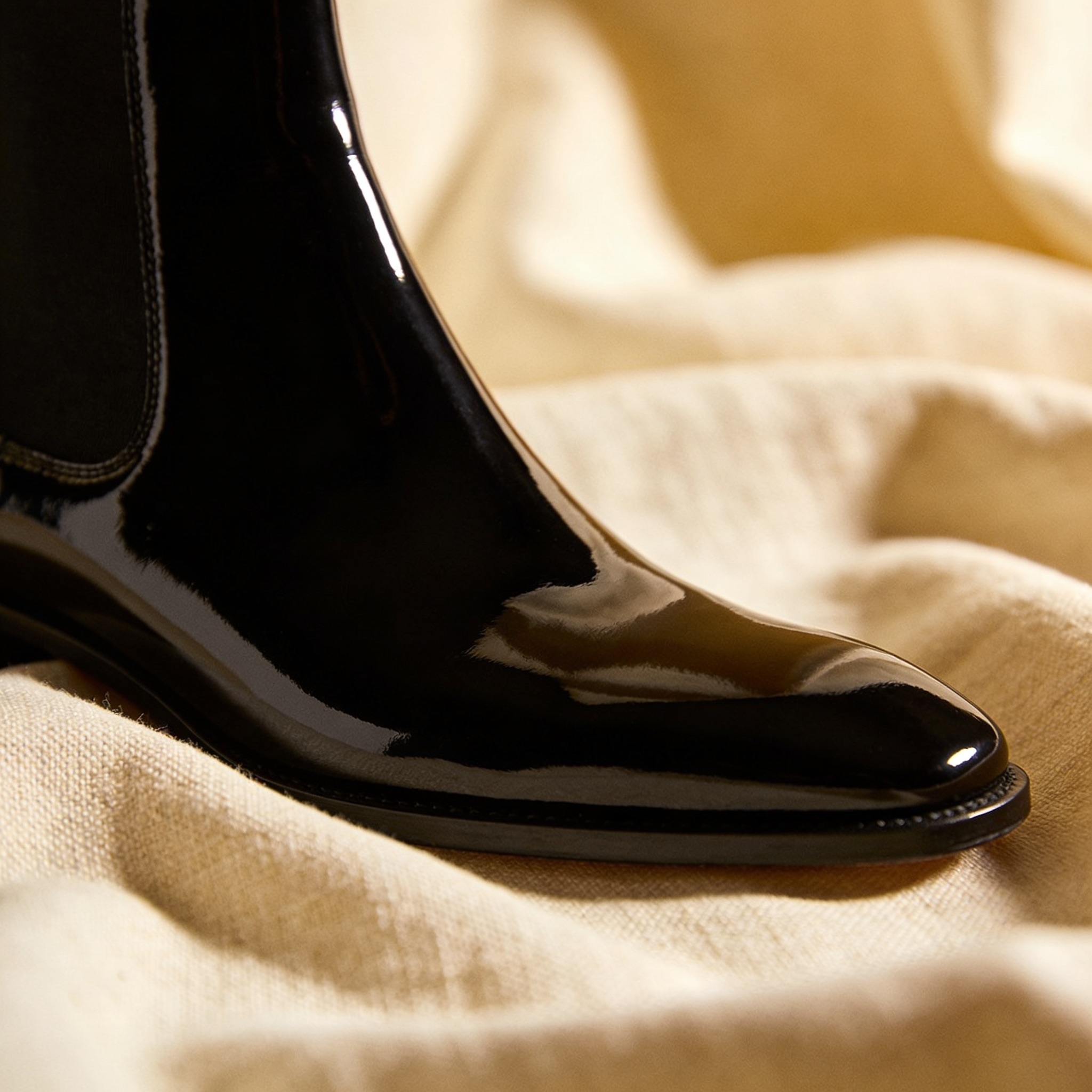
Patent leather announces itself. The high-gloss finish reads across a room, which is the point — and which is also why every fingerprint, every scuff, every smear of something unidentifiable announces itself with equal confidence. Cleaning patent leather correctly is less about the product and more about understanding what the surface actually is: a lacquer coating over leather. You are cleaning the coating. The leather underneath is mostly a bystander.
How to clean patent leather shoes and bags correctly means using gentler methods than you might use on smooth calfskin, and avoiding anything abrasive that scratches the lacquer rather than the surface beneath it.
What Patent Leather Is — and What It Isn’t
The finish that gives patent leather its shine is a plastic or acrylic lacquer — occasionally polyurethane — applied in multiple thin coats over the prepared leather surface. The leather underneath is real, but the surface you see and touch is the coating.
This has consequences for care. The coating does not breathe the way unfinished leather does. It does not absorb conditioner. It does not develop a patina. What it does is reflect, and what it loses over time is that reflection — to micro-scratches, transfer marks from other materials, and eventually, cracking as the coating ages.
The best patent leather care is gentle and consistent. The worst is abrasive and infrequent.
What You Need to Clean Patent Leather
For routine patent leather cleaning:
- Soft, clean cloth — microfibre is ideal, free of particles that could scratch the lacquer
- A damp cloth for smudge removal — lightly wetted, not saturated
- Petroleum jelly (Vaseline) — the most versatile at-home tool for patent leather. Removes light scuffs, restores shine, provides a thin protective layer.
- Patent leather cleaner — products like Saphir Vernis Patent Leather Cleaner are specifically formulated to clean without attacking the lacquer
What to avoid: saddle soap (too waxy and dulls the finish), standard leather conditioner (does nothing useful on a coated surface), abrasive cloths or brushes, and acetone-based products used without extreme caution.
How to Clean Patent Leather Shoes
Routine cleaning of patent leather shoes is straightforward — the high-gloss surface shows fingerprints and smudges clearly, but releases them easily.
-
Wipe with a soft, slightly damp cloth. This removes most surface dust and fresh smudges. Work gently in small circular motions across the full surface.
-
Apply petroleum jelly for shine. A small amount on a clean cloth, buffed in circular motions, restores the mirror finish and provides a light barrier against future marks. Wipe off the excess with a clean section of cloth. The result is a clean, glossy surface — and this is the step most people skip, reaching for something that sounds more sophisticated when Vaseline does the job.
-
For stubborn smudges and colour transfer, a patent leather cleaner applied with a cotton pad works on marks that a damp cloth leaves behind. Apply a small amount, work gently, and buff clean.
-
Store patent leather shoes away from coloured leather and fabric. Patent leather is unusually prone to picking up colour transfer from adjacent materials — a dark suede shoe stored against a patent leather shoe can leave a dye shadow that is very difficult to remove.
How to Remove Scuff Marks from Patent Leather Shoes
Scuffs on patent leather are common, particularly on shoes where the toe box catches the back of the other shoe when walking. Most are surface transfers — marks from another material left on the lacquer rather than damage to it.
Petroleum jelly method: Apply a small amount to a clean cloth and work it into the scuff mark using circular motions. The jelly helps dissolve the surface transfer and lifts the mark. Buff clean with a dry section of cloth. This works on the majority of light scuffs.
For more stubborn marks: A tiny amount of isopropyl alcohol or nail polish remover on a cotton swab, applied directly to the scuff and not the surrounding area, can dissolve deeper colour transfers. Use this carefully — too much will dull the lacquer. Work in one small area, assess, and repeat only if needed.
If the scuff has scratched the lacquer rather than transferred colour onto it, it may not lift fully with any home method. Scratched lacquer — visible as a dull or white-edged mark in the finish — requires professional refinishing to address.
How to Clean Patent Leather Shoes with Scuff Marks at the Edge
The toe box and heel counter collect the most damage on patent leather shoes. Cleaning patent leather shoes with scuff marks around these edges follows the same method, but requires patience with the geometry — the curved surface near the toe makes petroleum jelly application slightly less even.
Work in small sections, apply the jelly sparingly (it is easy to use too much and leave a greasy residue), and buff from the centre of the scuff outward. For heel counter scuffs, hold the shoe under a light source at an angle to see whether the mark has fully lifted before moving on.
How to Clean a Patent Leather Handbag
Cleaning a patent leather handbag requires the same tools and approach, with additional care around structured edges, seams, and hardware. The flat panels of a patent bag clean quickly — the areas around piping, corners, and any topstitching need lighter pressure to avoid stress on the construction.
For routine cleaning, a damp cloth across the flat surfaces followed by a light petroleum jelly buff is usually enough. For stains on light or white patent leather — which shows everything — a patent leather cleaner rather than petroleum jelly gives more control over the result.
Avoid storing patent bags stacked against each other or against other leather. The transfer issue applies equally to bags: a patent clutch stored inside a dark leather tote will pick up colour from the lining over time.
When Patent Leather Starts to Crack
Patent leather that has begun to crack is in a different category from scuffed or dirty patent leather. Cracking is the lacquer coating failing — usually from age, temperature cycles, or dryness in the underlying leather.
At home, cracking cannot be reversed. Some products marketed as patent leather restorers can temporarily soften or conceal fine cracks, but they do not restore the integrity of the coating. For bags and shoes with significant cracking, professional restoration — applying a new lacquer layer after cleaning and preparing the surface — is the only reliable solution.
Prevention is more effective: keeping patent leather away from extreme heat (car interiors in summer, radiators in winter), storing in dust bags, and not over-bending patent items, which stresses the coating.
What Fixano Restores
Patent leather restoration — including lacquer refinishing on cracked or clouded surfaces, scuff removal, and colour correction on marked pieces — is part of the Fixano shoe restoration service. Most cleaning and light restoration work on patent shoes returns in 2–3 days. For bags with more extensive lacquer work, 5–7 days is typical. See how to remove scuff marks from shoes for scuff guidance that also applies across other leather types.
When the patent finish has gone beyond what a cloth and petroleum jelly can address, the Fixano app connects you with restoration specialists across Los Angeles and Orange County. Photograph the shoes or bag, describe the issue, and get a clear answer before attempting further home treatments.