
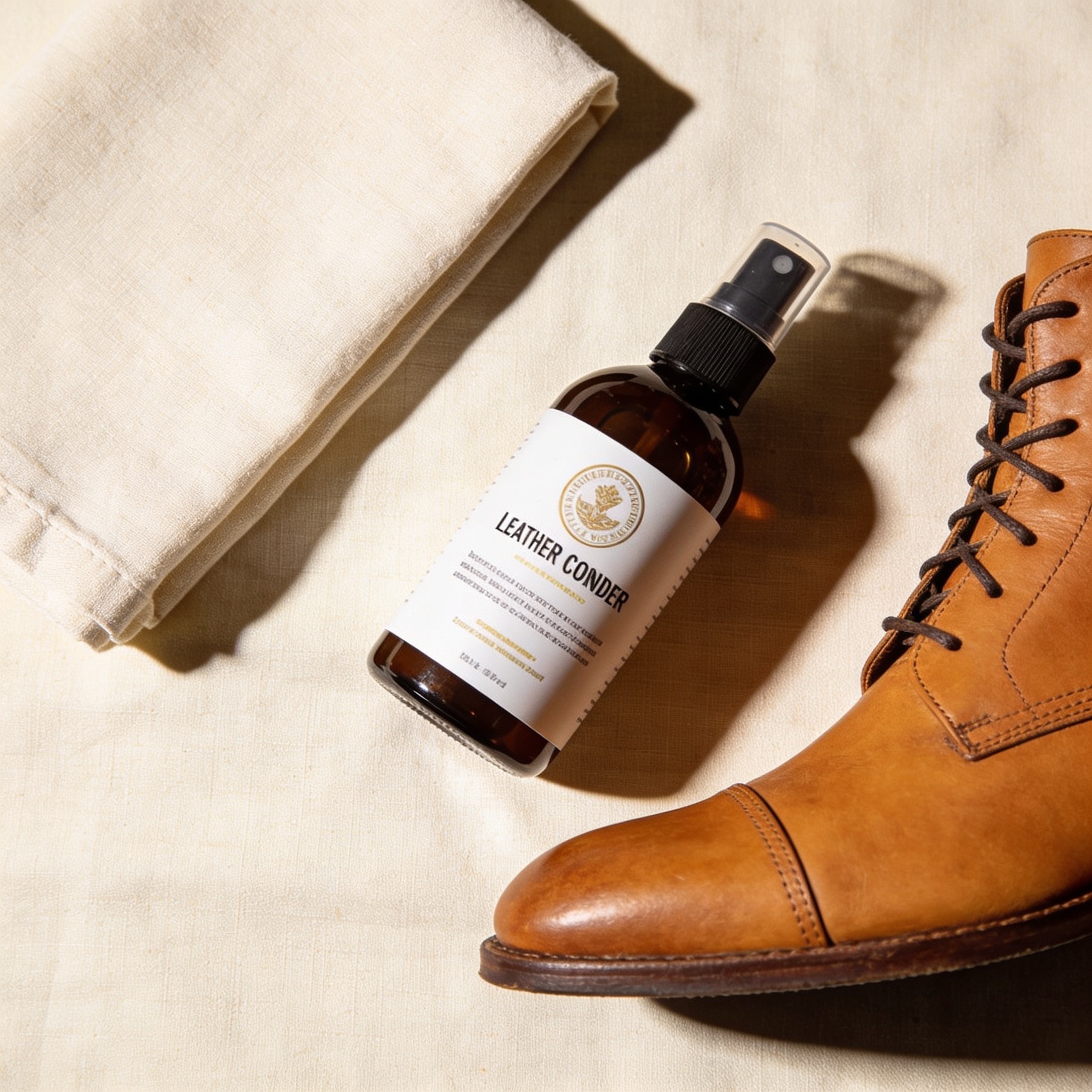
Leather conditioning is the maintenance task that nobody does often enough and nobody thinks about until the leather cracks. At which point the leather is telling you, with some justification, that it deserved better. A leather conditioner restores the oil and moisture balance that keeps the fibres supple. It is the single most important regular care step for any leather item — shoe, boot, bag, or jacket — and it is also one of the most commonly done wrong.
The most common mistake is not conditioning at all. The second most common mistake is using a product sold as a conditioner that isn’t one. How to condition leather correctly starts with understanding what the product is doing, and which products actually do it.
What Leather Conditioning Is — and What It Isn’t
Leather is a natural material. It contains oils and moisture that keep the fibres supple. As leather ages and is exposed to sunlight, heat, and regular use, those oils migrate and evaporate. The leather becomes increasingly dry. If left unconditioned for long enough, it begins to crack — first at the surface, then at depth.
A leather conditioner restores the oil and moisture balance. The best conditioners use lanolin, beeswax, neatsfoot oil, or similar natural lipids that the leather’s collagen fibres can actually absorb. The conditioner penetrates the surface and feeds the material rather than sitting on top of it.
What most products sold in drugstore leather care aisles are not doing: they are applying a thin silicone or wax coating that creates the appearance of conditioning without the substance. Silicone sits on the surface of the leather rather than penetrating it, seals the leather rather than feeding it, and builds up with repeated use into a layer that cracks independently of the leather underneath. If the conditioner you are using comes in a bottle that fits in your medicine cabinet and costs under five dollars, it is probably a polish with a conditioner’s name.
Fixano had to learn this distinction early — and the customer who arrives with a bag that has been “conditioned” monthly for three years with a drugstore product often presents with more complex surface work than the customer who used nothing at all.
Choosing a Leather Conditioner
The conditioners that Fixano consistently finds reliable:
- Leather Honey — a US-made formula based on natural oils, works across most smooth leather types
- Saphir Renovateur — a French formula using mink oil, beeswax, and lanolin, considered one of the best available for fine leather
- Chamberlain’s Leather Milk — a water-based formula, less dense than traditional oil-based conditioners, good for leather that needs frequent application
- Bick 4 — lighter formula, good for leather that doesn’t need a heavy feed
For suede and nubuck: these materials do not use conventional leather conditioner. They have their own products — see how to restore suede shoes for that approach.
For exotic leathers (python, crocodile, ostrich): specialist products are required. Standard conditioners can alter the natural finish of exotic leather irreversibly.
How to Condition Leather Shoes
Step 1 — Clean first. Conditioning without cleaning first seals surface dirt and oil into the leather. A quick wipe with a leather cleaner or a damp cloth removes the surface layer before the conditioner goes on.
Step 2 — Apply conditioner sparingly. The instinct is to use more product because more seems more effective. Conditioner works through absorption — too much product sits on the surface and becomes a dust magnet. A pea-sized amount on a clean cloth is enough for a shoe or small bag panel.
Step 3 — Work it in. Apply with the cloth in circular motions, covering the surface evenly. Avoid saturating seams or stitching, as excess moisture in stitching can cause thread to swell and stress the seam over time.
Step 4 — Allow to absorb. Give the conditioner 10–15 minutes to penetrate before the next step. Some denser conditioners benefit from being left overnight.
Step 5 — Buff off excess. Any conditioner remaining on the surface after absorption is buffed off with a clean, dry cloth. This prevents a tacky surface and distributes any remaining conditioner more evenly.
Step 6 — Polish if needed. Conditioning comes before polishing — conditioning feeds the leather, polishing finishes the surface. If you apply polish without conditioning first, you are adding shine to dry leather, which addresses the appearance without the substance.
How to Condition Leather Boots
Conditioning leather boots follows the same process, with additional attention to:
- The shaft above the vamp on tall boots — this area is often missed because it’s less visible, but it dries as fast as the toe box and shows cracking first
- The welt area where the upper meets the sole — a frequently dry area, often ignored
- After salt exposure — road salt is one of the most damaging things for leather boots. Clean salt off thoroughly with a damp cloth, dry naturally, then condition. Do not condition before cleaning the salt off, as the conditioner can draw the salt deeper into the leather
How often to condition leather boots depends on use. Boots worn regularly in autumn and winter: every 4–6 weeks during the season. Boots in summer storage: once before storage, once when brought back out. Boots exposed to rain or salt: condition after every prolonged exposure.
How to Condition a Leather Jacket
Conditioning a leather jacket requires particular attention to the areas of highest movement: the elbows, the underarm seam, and the collar. These areas flex more than any other and are the first to crack if the leather becomes dry.
Apply conditioner section by section on a laid-flat jacket rather than trying to condition it on a hanger. The shoulder and sleeve areas need to be reached fully — holding the jacket up while conditioning makes it easy to miss sections along the seam lines.
For vintage or softened leather jackets (lambskin, perforated leather, or distressed finishes), use a lighter conditioner and test on an inconspicuous area first. Some finishes absorb conditioner very quickly and darken if too much is applied.
How Often to Condition Leather
The honest answer to how often to condition leather is: look at the leather and let it tell you.
Leather that is supple, soft, and returns colour evenly when pressed lightly does not need conditioning. Leather that looks slightly dull, feels stiff at flex points, or where the surface dye looks faded or uneven is dry and needs conditioning.
As a baseline:
- Shoes and boots worn regularly: every 4–6 weeks
- Leather bags in daily use: every 2–3 months
- Leather jackets: twice a year minimum, more if worn in dry conditions
- Items in storage: once before storage
What Fixano Restores
Leather that has been allowed to dry beyond the point where conditioning alone can recover it — cracked surface, deeply dried-out structure, condition that has gone beyond maintenance into damage — is the starting point for leather restoration. The how to store leather bags guide covers the storage step, which is where conditioning before long-term storage makes the most difference.
When the conditioning has been missed for too long and the leather has started to crack, the Fixano app connects you with restoration specialists in Los Angeles and Orange County. Photograph the item and describe the condition — the assessment is honest about what’s recoverable and what the work involves.